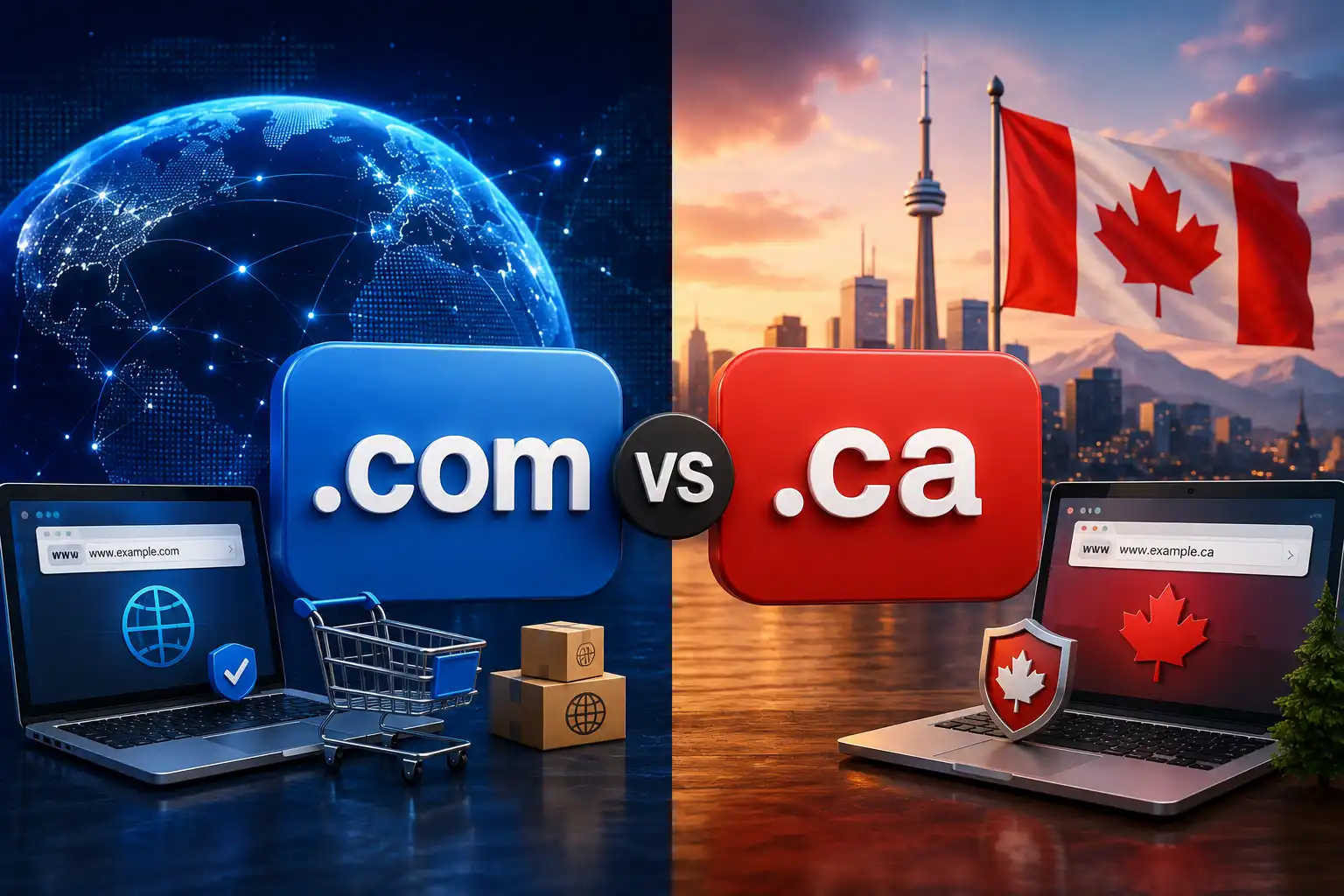
Picking a domain feels like a five-minute decision until you're staring at a registrar page with the exact same name available in both .com and .ca. It's a small choice with real, lasting effects on trust, SEO, and how easily you can expand later. Here's how to actually decide.
What the extension signals
A domain extension, technically a top-level domain (TLD), is more than a formality. It tells both users and search engines something about where a business operates.
.com is a generic TLD, open to anyone, anywhere. It's the most recognized extension globally and carries no geographic signal.
.ca is a country-code TLD reserved for entities with a genuine Canadian presence. It immediately signals "this is a Canadian business" to anyone who sees it.
That geographic signal is the whole ballgame for this decision.
Where .ca wins
Local trust. Canadian consumers show a real, measurable preference for buying from Canadian businesses and shopping on Canadian sites. If your customers are primarily in Canada, a .ca domain reduces friction before they've even landed on your site. The extension itself does some of the trust-building work.
Local SEO signals. Google uses ccTLDs like .ca as one signal (among many) that a site is relevant to searchers in that country. It's not a silver bullet, but for a business competing primarily for Canadian search traffic, it's a small structural advantage that a .com doesn't carry on its own.
Registration requirements act as a quality filter. Because .ca domains require proof of Canadian presence, the namespace is naturally less cluttered with spam and low-quality sites than the wide-open .com space, which can work in your favour for perceived credibility.
Where .com wins
Universal recognition. .com is so deeply embedded in how people think about the internet that many users will type it by default even when they mean to reach a .ca site. It's the extension people assume, absent other information.
No geographic ceiling. If you have any plans to sell outside Canada (the U.S., international markets, or just don't want your brand to read as "Canada-only"), .com doesn't box you in the way .ca implicitly does.
Simplicity for cross-border brands. A single global domain is easier to market, easier to remember, and avoids the "which one do I use" confusion that comes with running both.
The real-world approach most brands take
Most growing Canadian brands don't actually choose one over the other. They register both and point the extension they're not actively using to their primary domain. This protects the brand from a competitor or squatter grabbing the other version, without adding real complexity, since only one site needs to be maintained.
If budget forces an either/or decision, the deciding question is simple: is your near-term customer base overwhelmingly Canadian, or do you need to look credible to a broader market from day one? Canadian-first, local-service, or Canada-only e-commerce brands: .ca first. Brands planning U.S. or global expansion within the next year or two: .com first, with .ca registered defensively.
It's one signal, not a strategy
Whichever extension you land on, the domain itself is a small piece of a much larger SEO picture. Content quality, site structure, and page-level optimization matter far more than the three letters after the dot. A .ca domain won't rescue a site with weak content, and a .com won't hold back a site that's genuinely well-optimized for Canadian search intent. If you're deciding on a domain as part of a broader push to grow organic visibility in Canada, that's exactly the kind of strategy work we cover in our SEO services.