The sales call is the one time an agency is working the hardest to impress you, and the worst time to allow them to run the agenda. The right questions turn that on its head. They take you off the pitch deck and into how the agency actually works: how they measure, what happens to your information and what happens if things go wrong, who does what, etc.
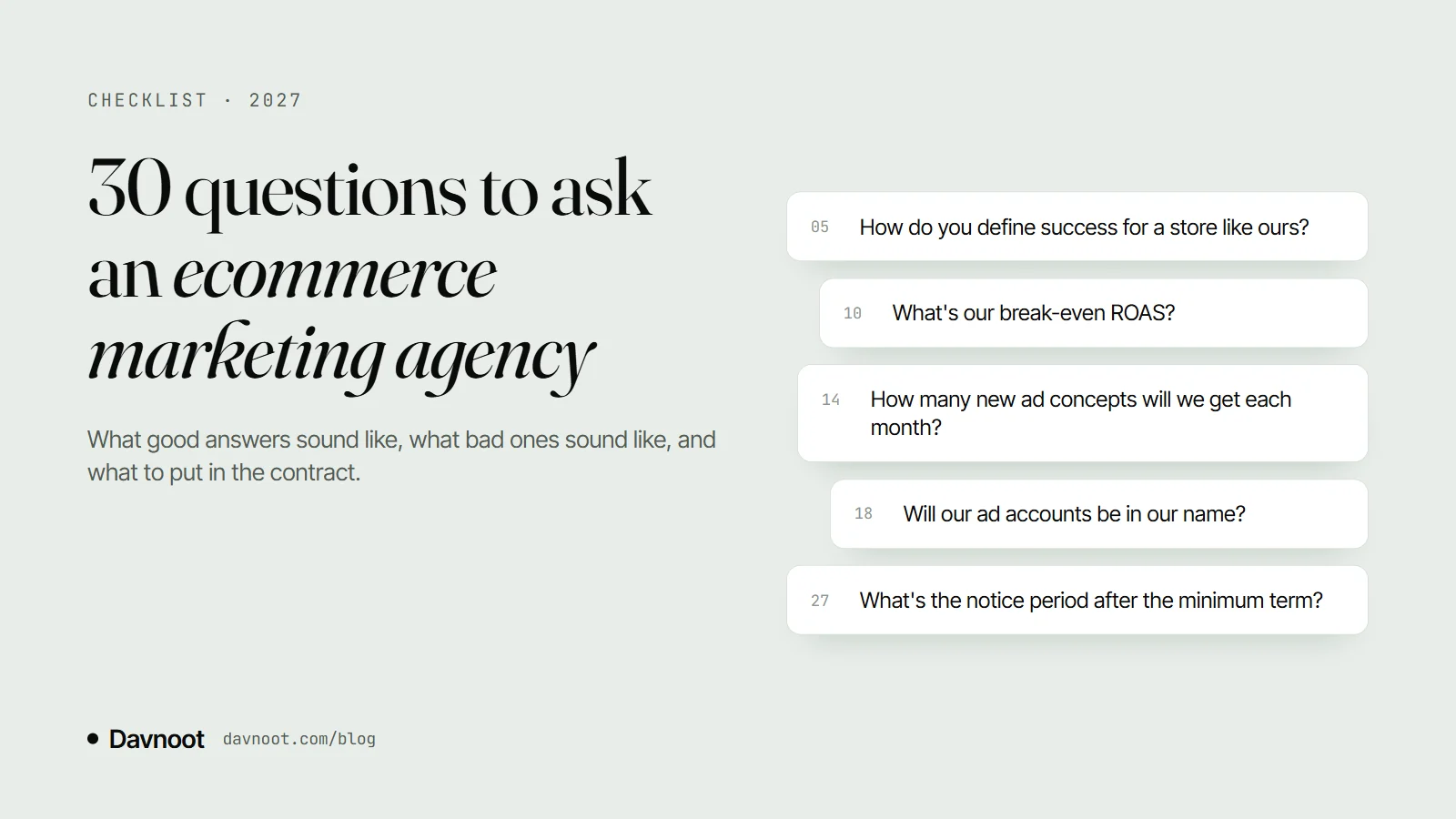
Listed below are 30 questions to ask an ecommerce marketing agency, organised into seven sections, with examples of answers you want, and answers you don't want, to help you identify a solid ecommerce marketing agency. Do not ask all 30! Choose the 10 that matter most for your business, email 5 of these before the call and ask the rest during the call.
Key takeaways
- Listen for details: numbers, names, timeframes and examples. The most obvious sign an agency is being less than honest is a fuzzy answer to a straightforward query.
- The most important questions are surrounding measurement and ownership. Weak creative is something that can be remedied later. It's much more difficult to recover from losing an ad account history.
- A good agency will ask you nearly as many questions as you ask it, particularly with regard to margins.
- Make sure that the important answers are in the contract instead of only on a call.
How to use this list
Think about this call as you would a job interview for someone who is seeking a five-figure monthly salary. Three rules help:
- Ask for examples, not opinions. "How would you handle a drop in ROAS?" gets you a speech. "Tell me about the last time a client's ROAS fell and what you did that week" gets you the truth.
- Notice who answers. If the salesperson answers all the questions and the strategist who would run your account doesn't say anything, then you are buying the salesperson.
- Record the answers and then compare them. The scorecard in our guide on how to choose an ecommerce marketing agency turns these answers into a number you'll be able to compare agency by agency.
Questions about strategy and fit
1. Which ecommerce brands like ours have you worked with, and what changed for them? Good answer: 2 or 3 appropriate examples, including a range of revenues, the channels involved, a time frame and before and after numbers. Worry if: all of the examples are big names you can't check, or none of them sell online.
2. From what you've seen so far, where do you think our growth is stuck? Good answer: a hypothesis – even one made on the fly – based on something they actually looked at (your product pages, your ad library, your email signup flow). Worry if: they give no comments until you sign.
3. What would you not do for us in the first 90 days, and why? Good answer: "We'll give TikTok a break until your Meta creative pipeline is up and running." Worry if: they wish to try it all at one time.
4. What would you need from us to succeed? Good answer: something specific, such as faster creative approvals, getting margin data, your promotion schedule, etc. Worry if: "Don't worry, we'll take care of it all."
Questions about measurement and reporting
5. How do you define success for a store like ours? Good answer: MER (total revenue / total marketing spend), new customer acquisition cost and contribution margin, with platform ROAS for support. Worry if: the answer is ROAS, clicks or impressions, and that's all.
6. How do you handle attribution when Meta and Google both claim the same sale? Good answer: they compare platform metrics with your actual store revenue, rely on blended metrics and conduct holdout or geo tests when the budget allows. Worry if: they only sum up the reports from each platform.
7. Can we see a sample report from a current client, anonymized? Good answer: a real report with written commentary about what has happened and what is to be done. Worry if: there are no conclusions and only charts.
8. How often will we hear from you, and what does each meeting cover? Good answer: some sort of set rhythm – for example, a 30 minute check-in once a week, a review of performance once a month and a planning session once a quarter. Worry if: "Whenever you need us."
9. What tracking will you set up or fix first? Good answer: details such as Meta's Conversions API, Google's enhanced conversions and GA4 events and consent settings. Worry if: they assume that you are currently tracking correctly, without checking.
Questions about your margins and unit economics
10. What's our break-even ROAS? Good answer: they want to know what your contribution margin is so they can calculate it, or they have made an estimate of it. Break-even ROAS is 1 / your contribution margin, so a 40% margin means break even at 2.5. Worry if: they don't understand the question.
11. How will you factor product margins into what you promote? Good answer: they'll invest in the higher margin products and bundles, and not the lower margin products that just look good on revenue. Worry if: they say they will promote your best sellers based on revenue and not profit.
12. How do you plan around inventory and stock-outs? Good answer: they monitor stock levels before scaling, and pause and/or redirect ads for products that are running low. Worry if: they haven't considered it.
13. How do you separate new customers from returning ones? Good answer: they report new customer revenue and acquisition cost separately, so retargeting people who already buy from you won't inflate the numbers. Worry if: all revenue is considered new.
Questions about creative
14. How many new ad concepts will we get each month? Good answer: a real number – one that defines what is or isn't a new concept, rather than a resized rendition of the same ad. Worry if: "As many as you need."
15. Who makes the creative, and is production included in the fee? Good answer: a clear split between what is covered by the retainer and what is not, such as UGC creators, shoots or motion design. Worry if: you only learn about production costs on the first invoice.
16. How do you decide what to test next? Good answer: a testing log or learning agenda showing that each test follows on from the previous test. Worry if: tests appear random.
17. Who owns the creative files when the contract ends? Good answer: you do, including raw footage and source files (which can be edited). Worry if: you would only receive the final exports, or none at all.
Questions about accounts, data and ownership
Out of all the items on the list, these five protect you more than any of the others. Ad account history, pixel data and e-mail lists are worth real money, and they are painful to rebuild.
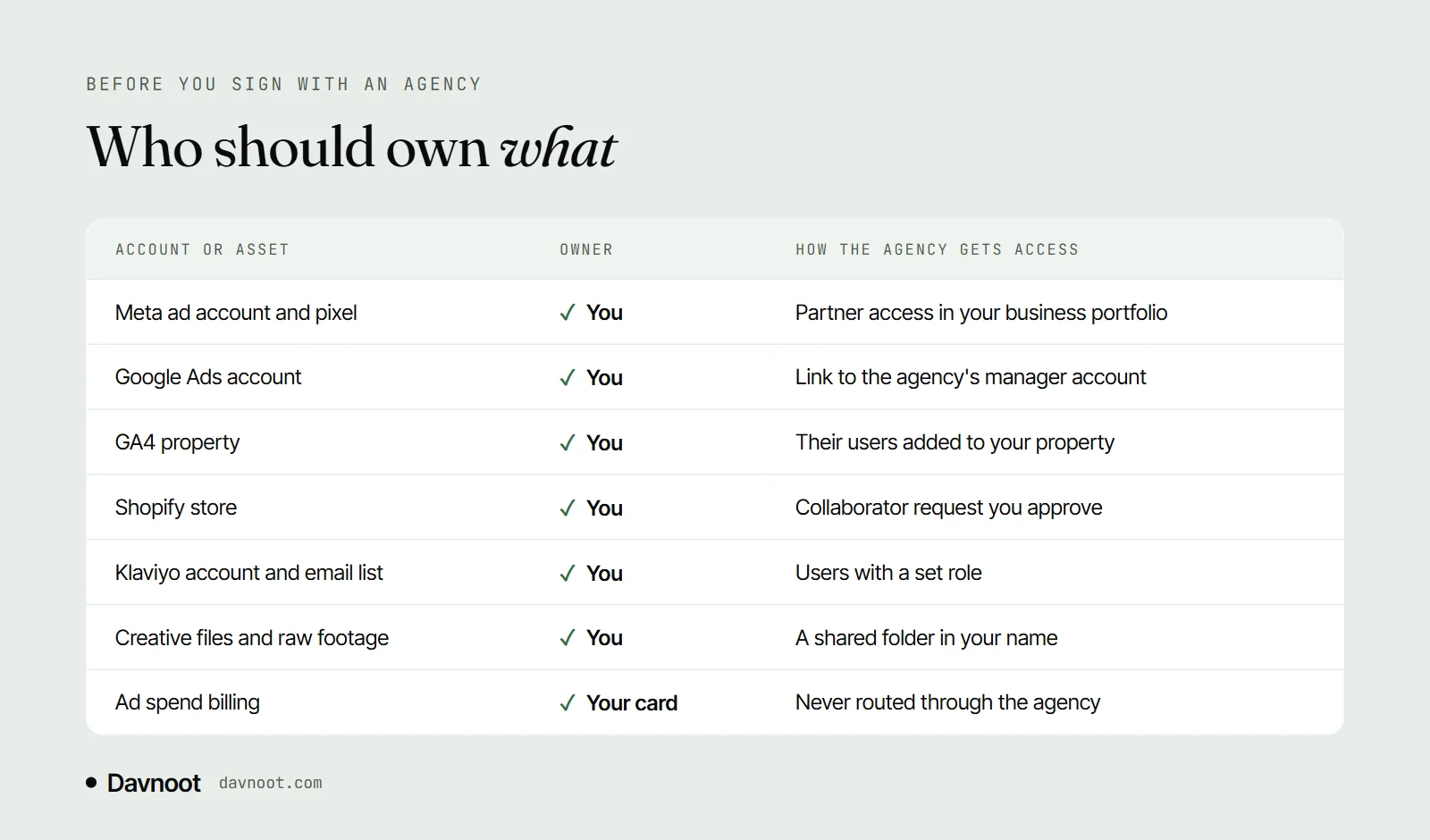
18. Will our ad accounts be in our name? Good answer: yes, all of them. You set up the accounts and the agency has access to them. Worry if: they want to place your ads in their own accounts "to keep things simple."
19. How will you get access without us sharing passwords? Good answer: each of these big platforms has the correct procedure for granting access. On Meta, you can add the agency as a partner in your business portfolio. On Google Ads, they connect their manager account with your account. In GA4, they are added to your property as users. In Shopify, they will send you a collaborator request, and in Klaviyo, you will add them to your users with a role. Worry if: they request your login information.
20. Who owns the pixel, the email list and the customer data? Good answer: you do, and the contract states it. Worry if: the answer is unclear.
21. What happens to our data, accounts and creative the day after we leave? Good answer: a written offboarding process: access removed, creative and reporting handed over, nothing deleted. Worry if: it's the first time they are being asked.
22. Is our ad spend billed directly to us? Good answer: yes, the ad platforms charge your card or your business directly. Worry if: they pay for the media and then charge you for it, which can lead to mark-ups.
Questions about the team
23. Who exactly will work on our account, and how experienced are they? Good answer: names, roles and experience, and you meet the strategist before you sign. Worry if: you only communicate with the founder or a salesperson.
24. How many other clients does our account lead manage? Good answer: a real number that leaves room for attention, usually 4-8 accounts for a hands-on strategist. Worry if: they won't say.
25. Is any of the work outsourced or white-labelled? Good answer: a straight yes or no, with details if it is yes. Hiring out doesn't have to be a bad idea. Hiding it is.
26. What happens if our account lead leaves your agency? Good answer: documentation, someone who is familiar with the account and a handover plan. Worry if: everything is in one person's head.
Questions about the contract and exit
27. What's the minimum term, and what's the notice period after it? Good answer: a brief initial term (usually three months), then 30 days' notice. Worry if: there's no way out for 12 months.
28. Is there a performance review built into the contract? Good answer: yes, generally around day 90, based on goals that you both decided on in the beginning. Worry if: success is never documented.
29. Are there setup or onboarding fees, and what do they cover? Good answer: a fee tied to specific deliverables, such as a tracking fix and a written audit. Worry if: a big initial payment with nothing specific attached.
30. What isn't included in the fee? Good answer: a clear list, such as creative production, landing page creation, software subscriptions and translations. Worry if: "Everything's included," and then there are surprises on the invoice.
The questions a good agency will ask you
You can learn as much about an agency from what they ask as from what they say. A good ecommerce agency will want to know:
- Your contribution margin, return rate and best sellers, by profit and not only by revenue
- Inventory depth and lead times for your most popular items
- How many customers place a second order, and how much time elapses between orders
- Your promotion calendar and the extent to which the brand can be discounted
- Cash flow limits, so they don't scale spend you can't afford
- What was previously done, and what happened
If an agency doesn't ask any of these questions but still brings you a complete plan, it was not written with your business in mind.
Contract clauses worth asking for
If you are considering signing, be sure to have these in writing in the contract:
- You own all your ad accounts, analytics properties, pixels, e-mail lists and creative files.
- A review of progress against agreed goals at 90 days.
- 30 days or less notice given following the first term.
- Ad spend billed directly to you, with no mark-up.
- A list of included items and what will be extra.
- A handover process, including access, files and reporting history.
If an agency resists all of this, then you've learned what you needed to learn!
What to do after the calls
Compare answers within 48 hours, before they become stale. Score each agency, check two references for each finalist (and ask what went wrong, not just what went right) and compare costs. Our breakdown of ecommerce marketing agency cost shows what each pricing model does to your margin at the same budget.
FAQ
What should I ask an ecommerce marketing agency before hiring them?
Make sure to consider four points: what they consider success (MER and contribution margin, not just platform ROAS), whether you'll own your ad accounts and data, who will be working on your account, and how you can get out of the contract. Request examples and sample reports instead of opinions.
Who should own the ad accounts when you hire an agency?
You should. Create your own accounts for each platform (Meta, Google Ads, GA4, Shopify and Klaviyo) and give the agency partner or user access. Don't run ads in an agency's own account; you could lose all of the account history and data when you leave.
How long should an ecommerce marketing agency contract be?
The typical and equitable structure is a three month initial term, followed by a 30 day notice period, and a performance review approximately 90 days into the job. Be careful with 12-month deals without any form of exit or performance clause.
What are the biggest red flags when hiring an ecommerce marketing agency?
Running your ads in their own accounts, only reporting platform ROAS, no ecommerce case studies with real numbers, long lock-in contracts, and pitching tactics before inquiring about your margins.
Want a second opinion on what you heard?
If you've had a couple of calls and need someone to review the answers you got, we can help. At Davnoot, one ecommerce team manages Shopify, Google Ads management, Meta Ads management and email for online stores, with one report and every account kept in your name. Book a free strategy call and bring your list.