The cost of an ecommerce marketing agency in 2027 depends on a variety of factors, including pricing models, fees, and what you should expect to pay.
Quick answer: if you're asking "how much does an ecommerce marketing agency cost in 2027?", the average range is $3,000 to $15,000 per month in agency fees, on top of ad spend. Single channel is typically $1,500-$7,500 per month. For brands with $1M to $10M in annual sales, integrated work across paid ads, email, and SEO is generally $5K-$12K per month. The agencies that charge a percentage of your ad spend typically take 10-20%, usually with a monthly minimum.
Those ranges are broad, and for a reason. Two agencies can give you the same fee for two different amounts of work, and the pricing structure can end up costing you more than the fee. This guide explores what ecommerce marketing agencies charge by service, how each of the four pricing models works as you grow, what costs are not included in the retainer, and how to calculate what your ecommerce store can afford.
All prices are in US dollars and are indicative of normal market ranges, not quotes.
Key takeaways
- Agency fees are separate from ad spend. A $5k retainer + $20k in ads is $25k per month in marketing, before software and creative.
- With percentage of spend pricing, the agency earns more money if you spend more, regardless of whether or not the additional spend is profitable.
- A flat retainer (or a base fee plus a bonus based on profit) is typically more in line with your interests.
- Work out your margins first and then work backwards to your budget. Understand your contribution margin and break-even ROAS before comparing quotes.
What ecommerce marketing agencies charge by service
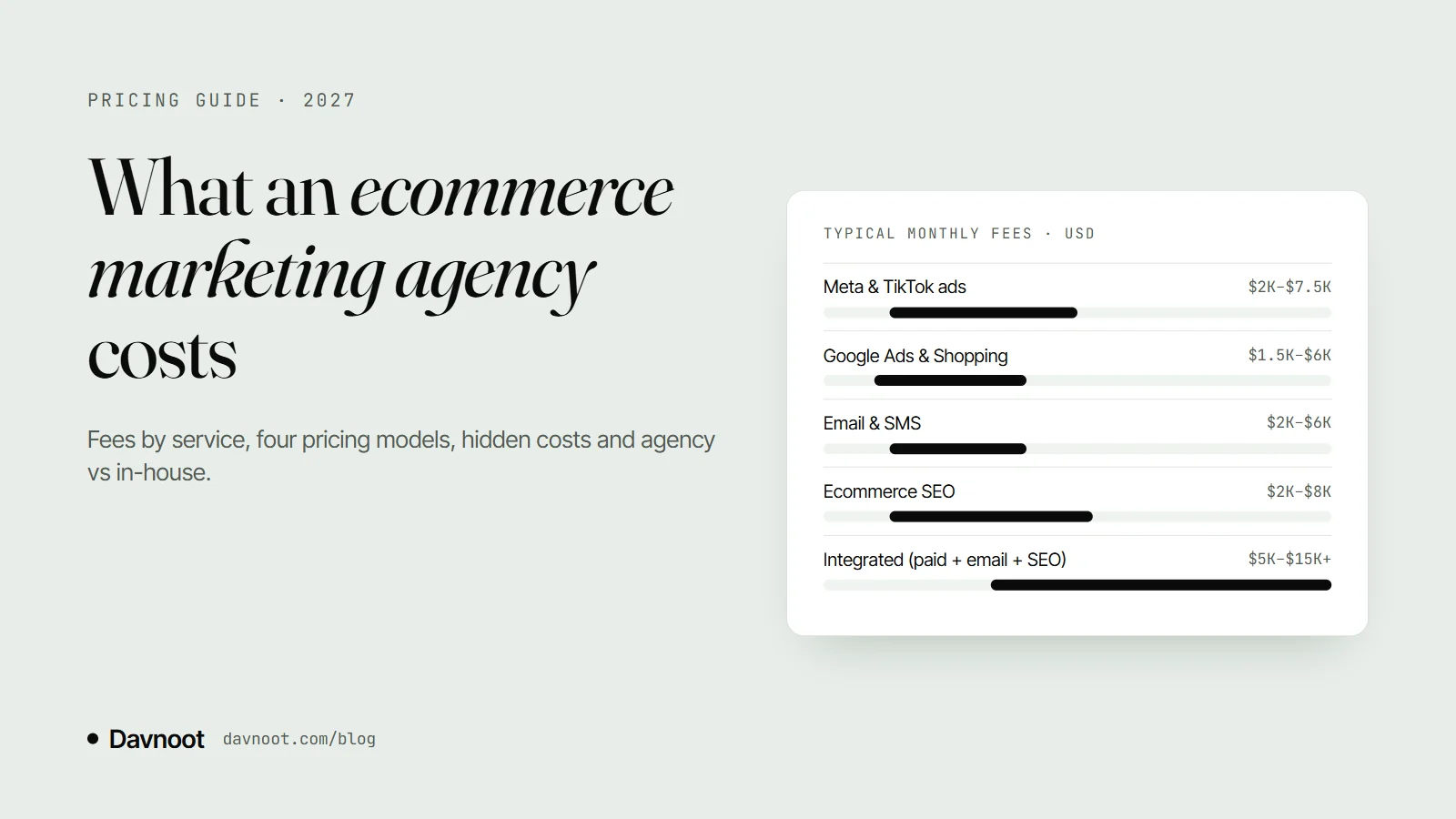
| Service | Typical monthly fee | What usually drives the price |
|---|---|---|
| Meta and TikTok ads management | $2,000 to $7,500 | Ad spend, number of markets, creative volume |
| Google Ads, Shopping and Performance Max | $1,500 to $6,000 | Catalogue size, feed work, number of campaigns |
| Email and SMS (Klaviyo) | $2,000 to $6,000 | Number of flows, campaigns per month, design work |
| Ecommerce SEO | $2,000 to $8,000 | Catalogue size, content volume, technical fixes |
| Integrated paid, email and SEO | $5,000 to $15,000+ | Channels covered, seniority, reporting depth |
One-off projects will be charged individually. Most paid media or tracking audits start at $1,500 and can be as high as $7,500. Creating a complete set of Klaviyo flows is typically $3,000 to $15,000. A Shopify build or redesign is another budget altogether, which we cover in our website design pricing guide.
The four pricing models, and what each one rewards
1. Percentage of ad spend
As a rule, the agency receives a percentage of your media spend, which is usually 10-20% with a minimum of $1,500-$3,000 per month.
- The good: it's straightforward and it is scalable with the size of the account.
- The bad: the agency gets paid more when you spend more. Even if doubling your budget drops your return from 3.0 to 1.8, your agency's fees also double.
- Best for: brands with established, consistent campaigns where spend and workload grow together.
2. Flat monthly retainer
A fixed monthly fee for a specific range of work.
- The good: it's predictable and eliminates the temptation to inflate your spending. The agency is paid the same whether it spends $20,000 or $15,000 of your money, so it can recommend cutting waste without cutting its own pay.
- The bad: if the scope is vague, a fixed fee can result in some quiet under-servicing. Establish deliverables up front – reports, meetings, and creative volume.
- Best for: most stores with sales ranging from $500,000 to $20 million per year. That's also the way we set our own prices, as described on our Google Ads pricing page.
3. Hybrid or performance-based
A lower base fee with a bonus depending on performance.
- The good: it shares the risk and rewards real growth.
- The bad: it only works when "results" is carefully defined. Heavy discounting and double counting can be rewarded through a bonus on platform ROAS or top line sales revenue. A bonus based on contribution profit or new customer revenue is much more difficult to game.
- Best for: brands that have clean data and a clear baseline to measure against.
4. Project-based
A fixed fee for a specific task, such as an audit, a tracking rebuild, a set of email flows, or a landing page.
- The good: it's easy to see what it costs and what it will deliver, and it's a low-risk way to test out an agency before signing a retainer.
- The bad: there is no one responsible for the continuous outcomes after the project is finished.
- Best for: a first engagement, or a particular gap your own team can maintain afterwards.
Same store, four fee structures: a worked example
On paper, fee models appear the same, but act very differently when scaled. Take an illustrative store:
- Monthly revenue: $120,000
- Monthly ad spend: $30,000
- Contribution margin before ad spend: 50%, or $60,000
- Contribution profit after ad spend: $30,000
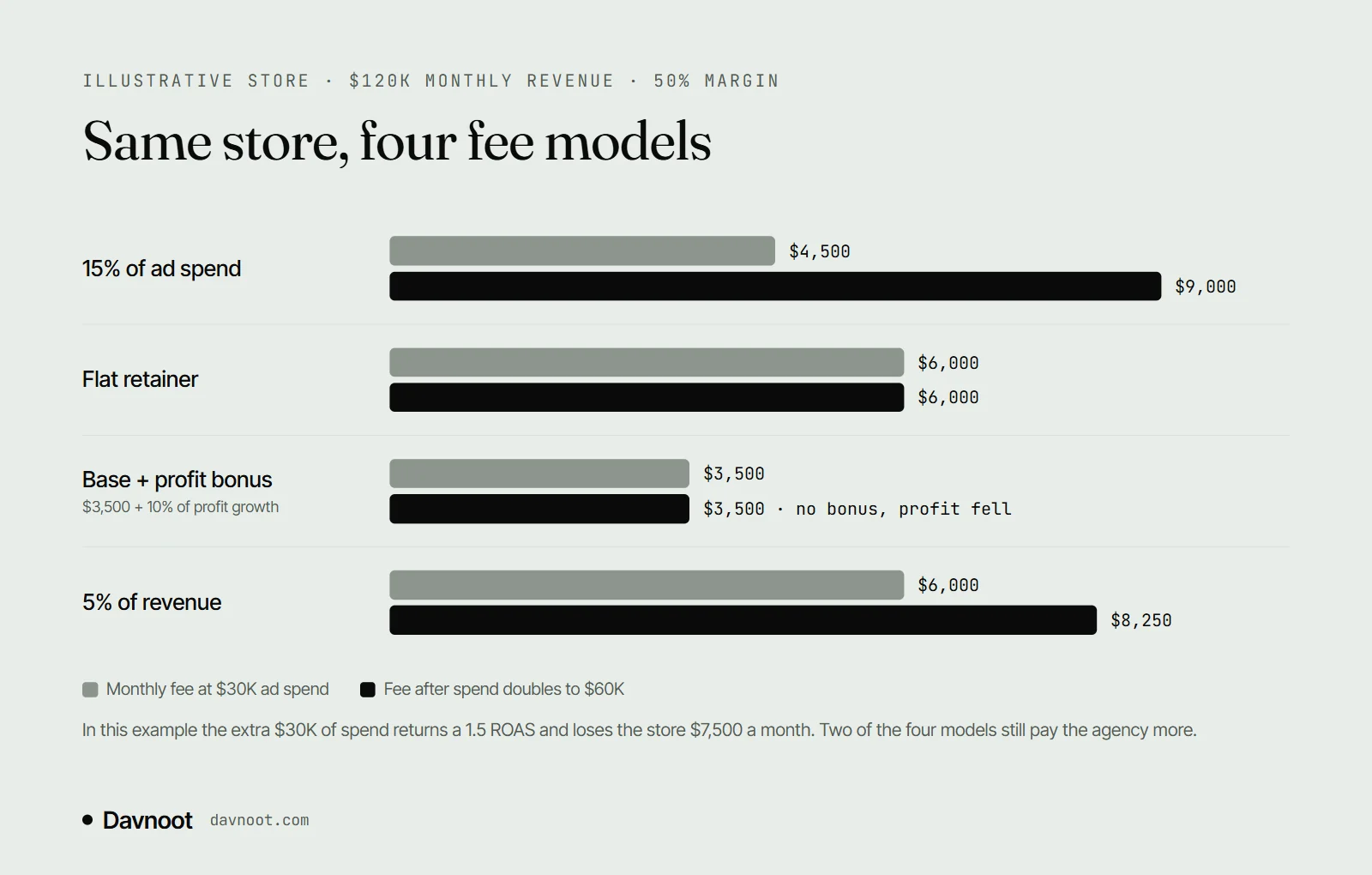
| Pricing model | Fee at $30K ad spend | Fee if ad spend doubles to $60K |
|---|---|---|
| 15% of ad spend | $4,500 | $9,000 |
| Flat retainer | $6,000 | $6,000 (until the scope changes) |
| $3,500 base + 10% of profit growth | $3,500 plus any bonus | $3,500 plus a bonus only if profit grew |
| 5% of revenue | $6,000 | Rises with revenue, even if profit falls |
Now, let's assume that the extra $30,000 of spend generates $45,000 in new revenue, which is a 1.5 ROAS on the additional spend. If the store's margin is 50%, it's an additional $22,500 of contribution for an additional $30,000 of spend, so the store is losing $7,500 per month on the increase. With the percentage model, the agency's fee still increases by $4,500. The store is $12,000 a month worse off, and the agency is better off.
A flat retainer doesn't give the agency any motive to urge that increase. If it were a profit-based bonus, it would actively be losing money by recommending it. Hence the model matters as much as the number on the proposal.
What pushes the price up or down
- Number of channels. Each extra channel must have a separate plan, management and reporting.
- Creative volume. It's a lot more expensive to create 30 new ads per month than it is to update five ads.
- Catalogue size. A 5,000-SKU store will require more feed, SEO and merchandising work than a 20-product brand.
- Markets and languages. Selling in English and French, or in both Canada and the USA, will involve separate campaigns and creative, and often separate tracking.
- Tracking complexity. Server-side tracking, consent setup and warehouse-level reporting all add real hours.
- Seniority. You pay for who does the work. A senior strategist is typically more expensive than a junior media buyer, and typically more valuable at higher spend.
Hidden costs that don't show up in the retainer
When comparing quotes, include these in the cost too:
- Ad spend. Always separate from the fee. Be sure to bill it to your own card; don't let it be marked up through the agency.
- Creative production. Often, UGC creators, photo shoots, video shoots or motion graphics are added on top.
- Software. As a growing store, it's not uncommon to spend $500 to $3,000 or more per month on Klaviyo, review apps, feed tools, analytics and attribution tools.
- Setup or onboarding fees. Fair as long as there are specific deliverables involved, such as a tracking rebuild and a written audit.
- Development work. When making landing pages or changing themes and fixing conversions, it is often necessary to employ a developer who is not part of the retainer.
- Translation. If you sell in Quebec, French ads and copy will be a real cost, and they should be written by a native speaker and not machine translated.
Agency vs in-house vs freelancer: what each really costs
The real question is rarely "agency or no agency?" It's which combination gives you the greatest bang for your buck.
| Option | Typical monthly cost | What you get | Main risk |
|---|---|---|---|
| In-house marketing manager | About $17,000 to $18,000 fully loaded | One person's skills, full focus, deep brand knowledge | One person can't plan strategy, buy media, write email and edit video |
| Freelancer | $1,500 to $6,000 | One specialist skill at a lower cost | A single point of failure with limited capacity |
| Integrated agency | $5,000 to $15,000 | A team across several channels | Fit, communication and how incentives line up |
| Agency plus an in-house lead | Both of the above | Strategy and brand ownership inside, execution depth outside | Highest total cost, so best for $5M+ brands |
The in-house number begins with the US Bureau of Labor Statistics' May 2025 median annual wage of $165,780 for advertising, promotions and marketing managers. Before benefits, payroll taxes, software and recruiting fees, that's approximately $13,800 per month.
How much should you budget for an agency?
Don't begin with a quotation, start with your margins.
- Determine your contribution margin, after product cost, shipping, payment fees and returns.
- Determine your break-even ROAS: 1 / contribution margin. At 50%, it's 2.0.
- Estimate the contribution profit the agency will be responsible for: the revenue generated from the channels the agency manages, multiplied by your margin, minus the spending on ads.
- Check the fee against that profit. If the fee takes up most of the profit you make from these channels, the numbers won't work at your current size, however good your agency is.
If the channels an agency manages bring in $25,000 a month in contribution profit, a $5,000 fee takes 20% of it. That's fine if the agency is increasing the number. A $12,000 fee would take up about half, which only makes sense if there's a plan for rapid growth.
If it still isn't working, begin with smaller stuff: one channel, a project-based audit, or a freelancer for the job that is in the worst shape!
Pricing red flags
- Full-service management for less than about $2,500 per month. Someone is cutting corners, typically on seniority.
- A percentage of the spend with no cap and no review point.
- The agency bills you for the media, and their markups are hidden in the agency's invoice.
- A performance bonus based on platform ROAS – the platforms tend to overestimate this.
- A high up-front setup fee and no listed deliverables.
- A 12-month contract, no exit clause.
On a sales call, our list of questions to ask an ecommerce marketing agency shows how to dig deeper into each of these.
How Davnoot prices ecommerce work
We charge a flat monthly retainer, not a percentage of ad spend, so our recommendations on the budget never affect our fee. There's no fixed list of prices because the work required for a 20-product skincare company and a 4,000-SKU outdoor retailer is vastly different. First we review your store and accounts, then quote based on a defined scope. On our pricing pages, you will see how we approach each discipline, including our social media advertising pricing.
If you're weighing up quotes at this time, book a free strategy call. We will show you where the opportunity is and what it should cost to go after it. If you're looking for the big picture on selecting a partner, check out our guide on how to choose an ecommerce marketing agency, or see how our ecommerce agency team operates.
FAQ
How much does an ecommerce marketing agency cost per month?
In 2027, the typical ecommerce brand spends $3,000 to $15,000 per month in agency fees, plus what it spends on ads. Single channel management begins at $1,500-$2,000, and for a brand with $1M to $10M in annual revenue, integrated paid, e-mail and SEO management usually costs $5,000 to $12,000.
Is a percentage of ad spend or a flat retainer better?
For most brands, a flat retainer will work better for you, as the agency isn't paid more depending on how much you spend. For large, stable accounts with a cap and a review point, percentage pricing may be applicable.
Is ad spend included in an agency's fee?
Almost never. Strategy, management and reporting are included in agency fees. All ad spend goes to the platform(s) and should be billed directly to your business.
Is it cheaper to hire in-house than to use an agency?
A lot of the time, not at the beginning. In the US, one experienced marketing manager costs roughly $14,000 per month in salary alone, without tools or benefits, and one person just can't do paid media, email, SEO and creative. In-house makes sense when the spend and complexity mean that a dedicated person, who may be partnered with an agency, is warranted.
What is a reasonable onboarding fee for an ecommerce agency?
Many agencies will have a one-time fee of about half to one month's retainer for a written audit, tracking fixes, account setup, etc. It's fair when the deliverables are specified in a contract.