Selecting an ecommerce marketing agency in 2027 could be a daunting task. The vast majority of store owners don't end up hiring the wrong ecommerce marketing agency due to carelessness. They're looking at the wrong data: a strong pitch deck, some familiar logos, a dashboard with a lot of green numbers. Six months later, the agency claims a 4x ROAS and the bank statement shows that the business didn't make as much money as last year.
Here's how to choose an ecommerce marketing agency the way we'd hope a friend would, before signing with us, or anybody else. It explains what a good agency does in 2027, what numbers you should have before your first call, how to tell real operators from good presenters, what fair pricing looks like and what the first 90 days should look like.
Key takeaways
- Measure an agency by MER (total revenue/total marketing spend), not by the ROAS each ad platform measures itself on.
- Calculate the contribution margin and break-even ROAS prior to the first call. A quality agency will request them. A weak one will never know what to do with them.
- Paid ads, email and SMS and SEO should not be three vendors with multiple scoreboards, but a single unit with one scoreboard.
- A written audit will be provided within 30 days, a measurement baseline will be provided by day 60 and an honest performance review will be provided by day 90.
What an ecommerce marketing agency should actually do in 2027
An ecommerce marketing agency designs and manages the tasks that drive traffic to your store, convert visitors to customers and re-engage them. In practice that encompasses five areas:
- Paid acquisition: Google Shopping and Performance Max, Meta, TikTok, Pinterest and – for a lot of brands – Amazon.
- Retention: Emails and SMS that convert a first order to a second and a third.
- Organic search: category and product page optimisation, and increased visibility in AI answers from ChatGPT and Google's AI Overviews.
- Conversion: product pages, offers, checkout and landing pages that determine if paid traffic pays off.
- Measurement: tracking, attribution and reporting that you can rely on when platforms don't agree.
Where the value is, is what's different now heading into 2027. Most of the bidding and targeting that agencies would charge for is automated in both Meta's Advantage+ and Google's Performance Max, making it almost a commodity to push buttons inside of an ad account. But the cost of attention is not on the decline either. The US Census Bureau reported that ecommerce accounted for 17.1% of US retail sales in Q2 2026, while Meta's Q3 2026 results revealed an average increase of 14% in ad price compared to the previous year, but just 10% in ad impressions.
That means there are four areas where the algorithms can't go alone without an agency's involvement – creative volume, clean first-party data, honest measurement and offers and margin decisions. If a pitch is too focused on targeting tricks and bids, then it's selling what the software can do for free.
Step 1: Know your numbers before the first call
Knowing what good looks like for your store is the only way to determine if an agency's results are good. Write down 5 numbers before talking to anybody:
- Average order value (AOV).
- Contribution margin per order before ad spend: revenue minus cost of goods, shipping/fulfilment, payment fees and average cost of returns.
- Break-even ROAS is 1 / your contribution margin. A 50% margin means that you are only breaking even at 2.0 ROAS. At 35% you need about 2.86.
- Repeat purchase rate: percentage of customers who make repeat purchases within 90 or 180 days.
- CAC payback: number of months required for a customer's contribution profit to cover the costs of acquiring the customer.
Let's take a look at an illustrative example. The average order value at a skincare store is $80. Product costs 30% of revenue, shipping and fulfilment is 12%, payment fees is 3% and returns is 5%. That leaves a 50% contribution margin, which means that the break-even ROAS is 2.0. If the owner desires to have 15% of the revenue as profit after ads, then they need to aim for a ROAS of 1 ÷ (0.50 − 0.15), which is approximately 2.86.
Now an agency that promises "a 3x ROAS" is making a claim that can be tested. If you don't have these numbers you are comparing adjectives. If your numbers are in three different spreadsheets and no one owns them, then that's the first thing to work out. Our list of KPI examples every business should track is a great starting point.
Step 2: Pick the agency model that fits your stage
There is no one proper agency. For your revenue, your team and your bottleneck, there's a right kind.
| Store stage (annual revenue) | Usual bottleneck | Model that tends to fit |
|---|---|---|
| Under $500K | One channel isn't working yet | A specialist or freelancer for that one channel |
| $500K to $5M | Channels don't talk to each other | An integrated agency running paid, email and SEO under one scoreboard |
| $5M and up | Speed and depth | An in-house lead plus an agency or specialists for execution |
A fully fledged retainer can consume the profit of a very small store. If a single freelancer is the restriction on a $3M store, it's a problem. Identify your choke point and then search for a model to address it.
Step 3: Judge agencies on the three things that matter most
They report MER, not just platform ROAS
Platform ROAS is the ROAS as reported by Meta or Google with respect to its own ads. This means if someone clicks on an ad on Google Shopping, then sees an Instagram story and buys, they can be counted twice, because both platforms are taking credit for the sale. It's also inflated by view-through conversions and sales that would've taken place regardless.
Marketing efficiency ratio (MER) is the ratio of total store revenue to total marketing spend. It is meant to be blunt, so nobody can double count it.
Ask each agency what success is. If the answer is platform ROAS, click-through rate or CPM, then they're optimizing the numbers they have control over. If they speak about MER, new customer acquisition cost and contribution margin, they are tweaking the numbers you live on.
They ask about margin before they ask for ad account access
The first call a good agency makes is somewhat similar to an interview with your accountant. Be prepared for inquiries regarding your margins, return rates, best and worst sellers by profit, inventory depth, and how cash flow is affected during large promotions. An agency that immediately comes up with campaign ideas has not yet figured out which campaigns will make you money.
They run paid, email and SEO as one system
Paid media is a strategy that brings in customers. Email and SMS are what convert a first time buyer into a repeat buyer, and that's where most stores make their money. Over time, SEO reduces the blended acquisition cost, since there is no media bill associated with organic orders.
If those three are managed by different vendors and each vendor issues their own report, each can boast a win with overall revenue remaining unchanged. If they have a common plan and measurement system, then the gains carry over. A practical test: what happens to a new customer who comes from a Meta ad in the first 30 days after their order? A great response will include the names of the particular Klaviyo email marketing flows, the offer, and when each will be sent.
Step 4: Check the 2027 table stakes
These used to be nice extras. In 2027, they are the minimum.
- A true creative testing process. Ask them how many new ad concepts they send out each month and how they determine which ad concepts to test. Ads are short-lived, and a non-specific response to this is too costly.
- Server-side tracking. Meta's Conversions API, Google's enhanced conversions and a clean GA4 setup recover conversions that browser pixels miss. An agency without an understanding of your current tracking problems can't measure its own work.
- Product feed management. The titles, images and attributes in your feed are the keys to the success of Shopping and Performance Max campaigns.
- Visibility in AI search. AI tools like ChatGPT or Google's AI Mode are now more often used by consumers to see what product to purchase. Check if the agency is monitoring whether your brand appears in those responses and what they do about it. This is a component of AI search optimization.
- You own every account. Your ad accounts, analytics, email platform, pixels and creatives should all belong to your business. The agency gets partner access, never ownership.
Selling in Canada? Two extra checks. In Quebec, the Charter of the French Language requires commercial advertising to be in French (another language may run alongside it), so ask who creates your French ads, and whether it is a native speaker or a machine. And Quebec's Law 25 changes how tracking and consent have to work for Quebec visitors. Our free Law 25 privacy policy generator covers the basics, but your agency needs to know the impact of consent on your conversion data.
Red flags and green flags
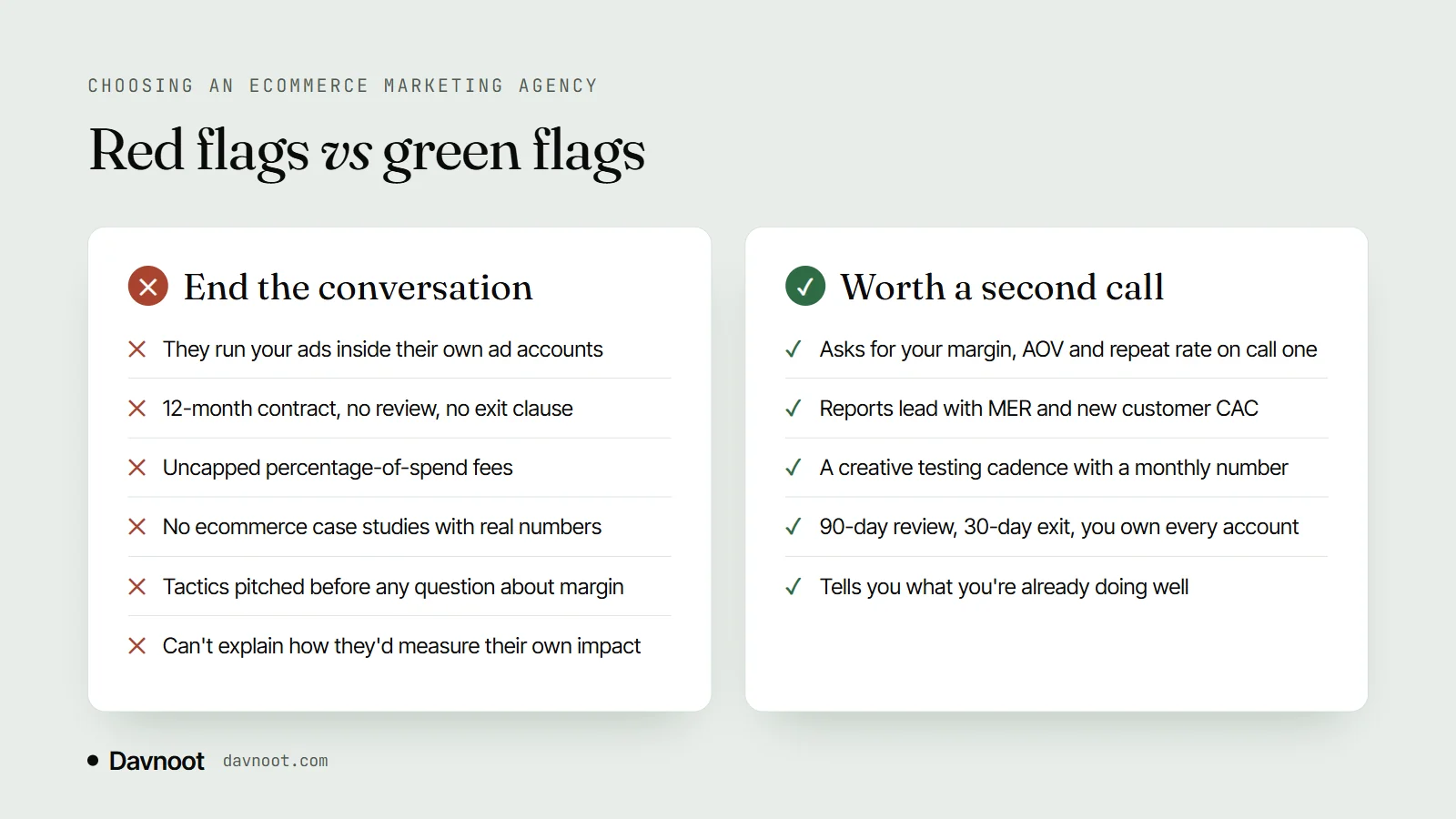
Red flags: end the conversation
- They wish to place your ads in their own ad accounts.
- A 12-month contract, never to be reviewed, with no exit clause.
- Percentage of ad spend fees with no limit, which are based on spending more, not spending better.
- No ecommerce case studies with actual figures, timeframes and baselines.
- They talk tactics before asking any question about your margins.
- They can't say how they would measure their impact.
Green flags: worth a second call
- In the initial meeting, they request your margin, AOV and repeat rate.
- Reports lead with MER and new customer acquisition cost, with platform metrics below.
- A consistent and clearly defined creative testing schedule with a monthly count.
- A contract that contains a 90-day review, a 30-day exit, and written confirmation that you own the accounts, data and creative.
- They identify something that you are doing well and should continue to do. If an agency says everything's broken, they're selling a rebuild.
How to compare proposals side by side
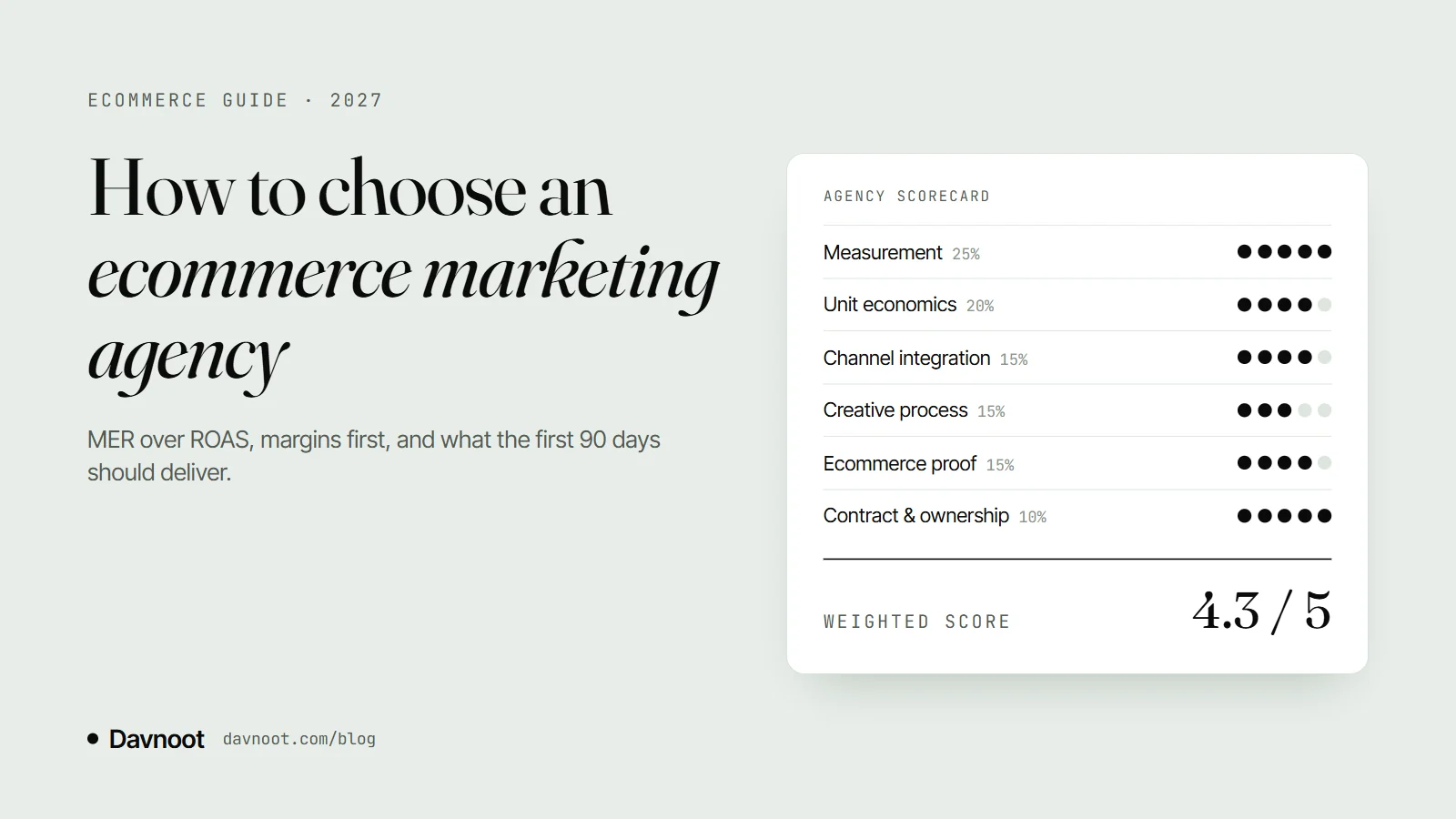
Proposals begin to get muddled after 3-4 calls. Score each agency from 1 to 5 on the criteria below, multiply by the weight and add it up.
| Criterion | Weight | What a 5 looks like |
|---|---|---|
| Measurement approach | 25% | MER and contribution margin first, with a plan to test incrementality |
| Understanding of your unit economics | 20% | Knows your break-even ROAS and built the plan around it |
| Channel integration | 15% | One plan and one report across paid, email and SEO |
| Creative process | 15% | Monthly testing volume, clear briefs, a running learning log |
| Relevant ecommerce proof | 15% | Case studies with spend, timeframes and baselines |
| Contract and ownership | 10% | You own everything, with a 30-day exit and a 90-day review |
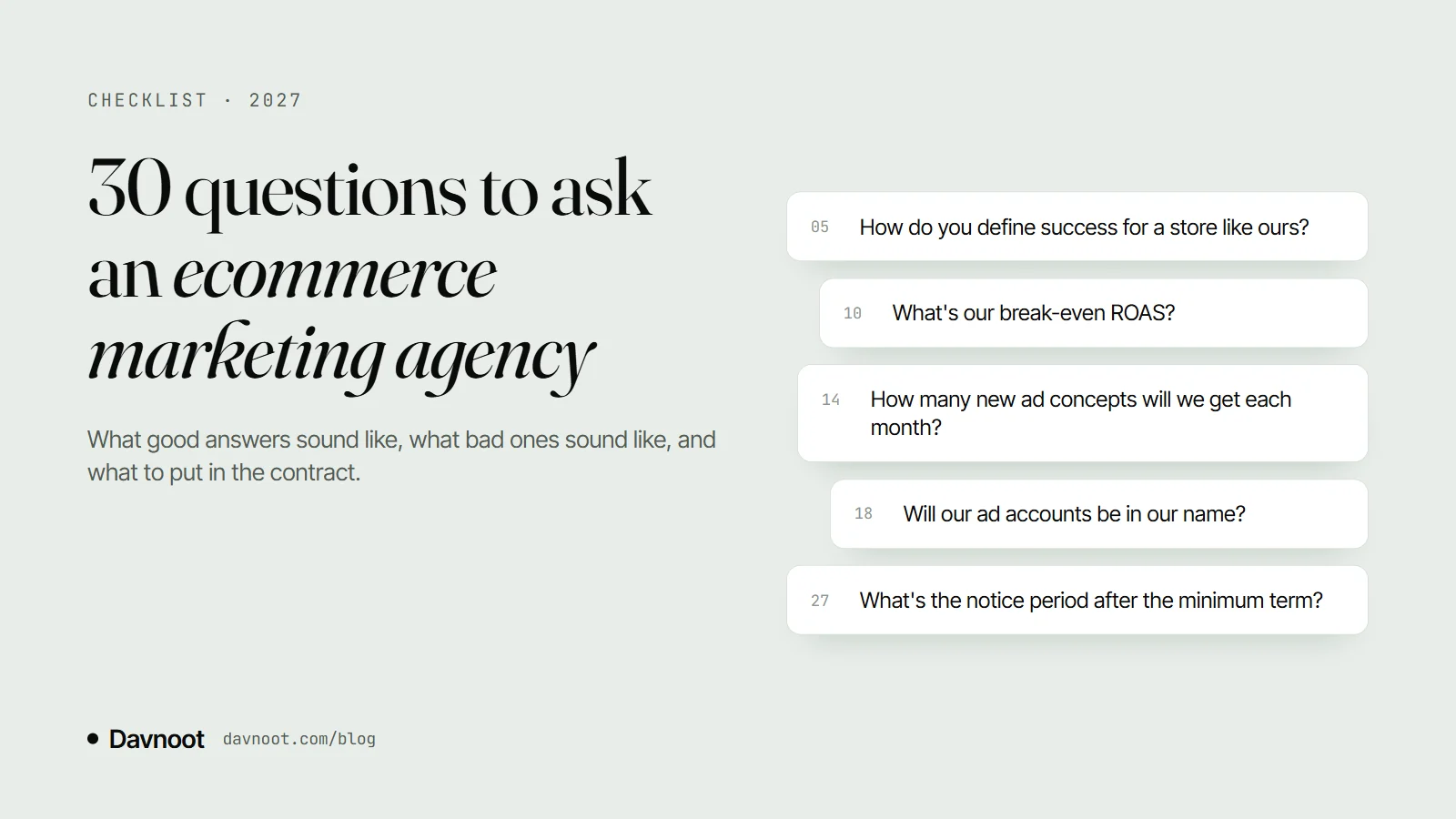
It's hard for the agency with the best deck to win this scorecard. The one that asked you the most difficult questions tends to do just that. Use our list of questions to ask an ecommerce marketing agency before you sign to form the questions you'll ask each agency individually.
What a fair price looks like
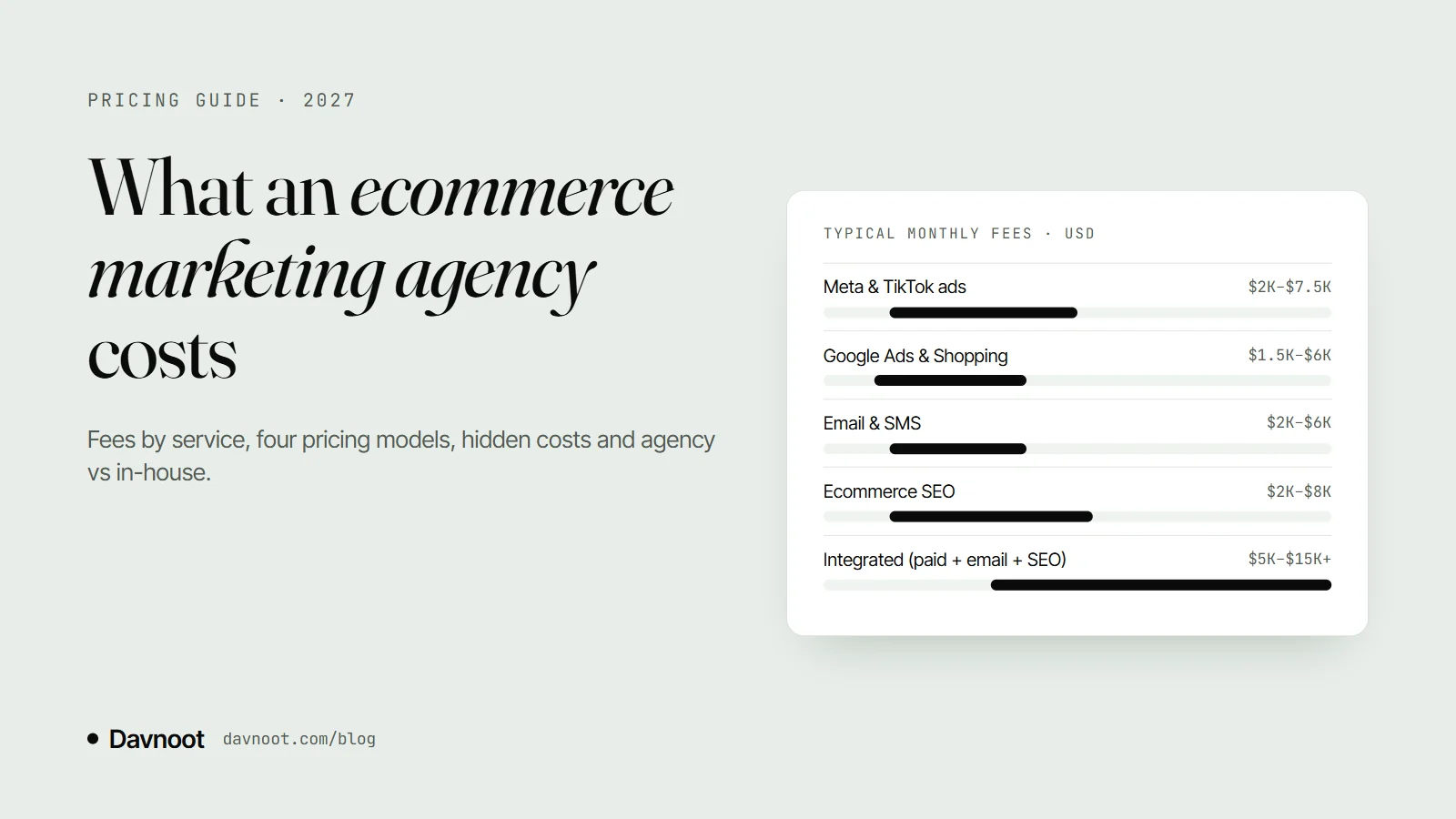
Most brands with annual revenue in the $1M to $10M range pay $3,000 to $15,000 a month in agency fees, in addition to the amount they spend on ads. Single channel management is on the low end. Typically integrated paid, email and SEO work for a growing store will cost between $5,000 and $12,000.
There are two extremes to beware of. A full-service quote that's under, say, $2,500/month usually means one of these: a junior team, outsourced execution or a scope that gets cut under the radar after you sign. And a fee set as a flat percentage of ad spend rewards the agency for increasing your spend even if it isn't profitable.
Our guide to ecommerce marketing agency cost explains each pricing model, and includes a worked out example at the same budget.
What the first 90 days should look like
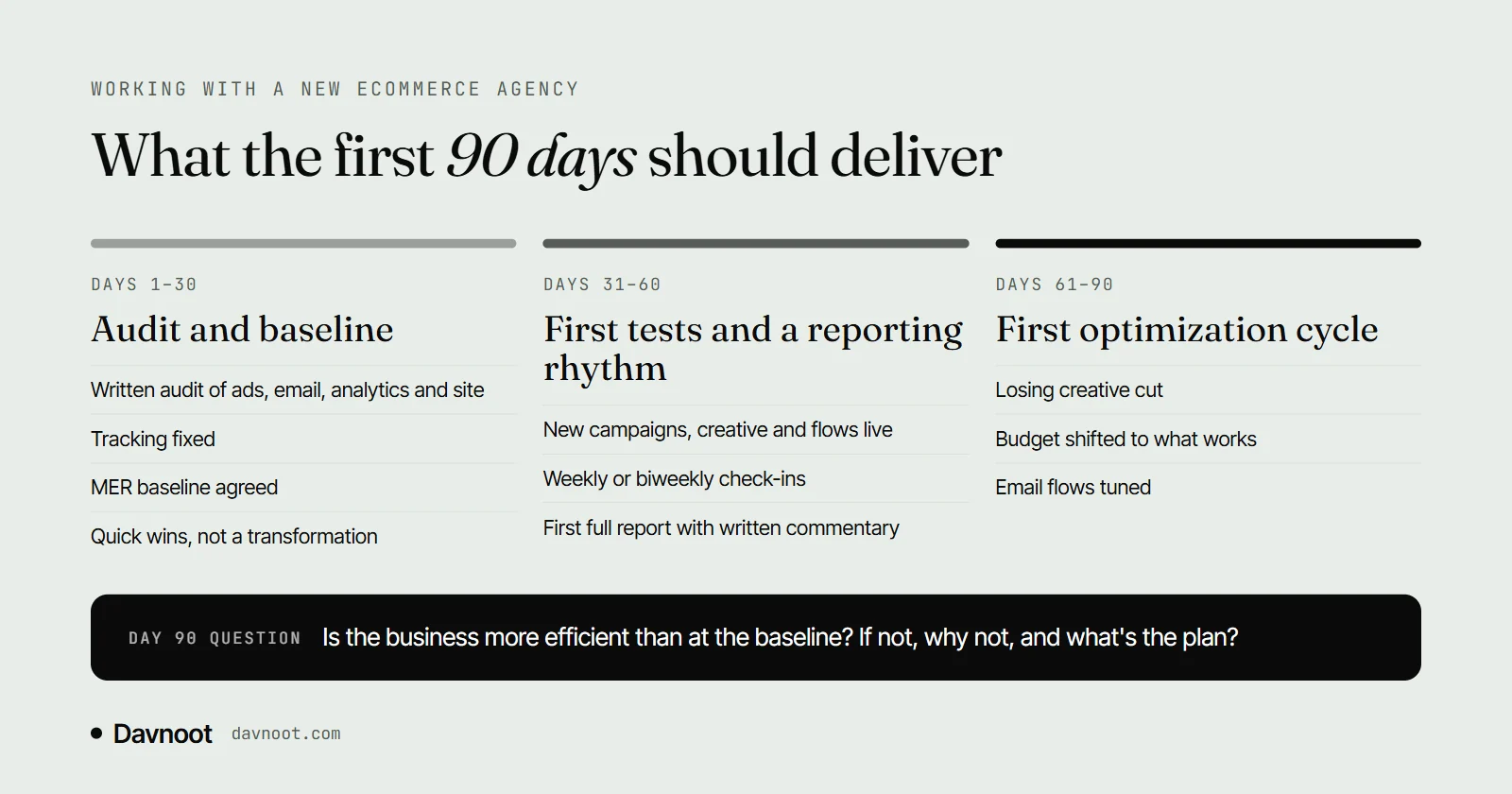
Days 1 to 30: audit and baseline. The agency will audit your ad accounts, email program, analytics and site, and provide you with a written audit. Tracking is resolved and a MER baseline agreed. Don't look for a transformation, but there will be some quick wins such as broken email flows or wasted search terms.
Days 31 to 60: first tests and a reporting rhythm. New campaigns, creative and flows are published. You get a check-in every week or two, and a first full report that includes MER figures, new customer acquisition cost and platform numbers, and written feedback on what's doing well and what isn't.
Days 61 to 90: the first optimization cycle. Losing creative is cut, budget reallocated towards what works and email is optimized. By day 90 you should know the answer to one question: is the business more efficient than at the base line, and if it isn't, then why not and what will you do about it?
When to walk away
Judge results against baseline, not against the pitch, and give a new agency 90 days before judging results. If after day 90 there is still no agreed MER baseline, late reports or reports without any commentary, no one can explain why performance has decreased, or the main recommendation is "increase the budget" without any margin math, walk away.
Have a straightforward discussion first. Any agency that does a good job will provide you with a simple diagnosis and a plan. If not, take advantage of the 30-day exit clause you agreed on in the beginning.
FAQ
How do I choose an ecommerce marketing agency?
Get your own numbers: contribution margin, break-even ROAS and repeat purchase rate. Next, narrow down the list to agencies that have actual case studies of their ecommerce results and judge them on how they measure success (MER over platform ROAS), if they ask you about your margins, if they run paid, email and SEO as one system, and if you will own all of your accounts. Score the proposals next to each other, rather than choosing on the pitch.
How long does it take an ecommerce marketing agency to show results?
Initial improvements will be expected in the first month, a measurement baseline at 60 days, and a good measure of performance at 90 days. SEO takes time, typically 4-6 months before there is any significant revenue from organic.
What is MER, and why does it matter more than ROAS?
MER (marketing efficiency ratio) is the total revenue divided by total marketing expense. Platform ROAS only reports the ROAS each individual ad platform claims for itself, and ad platforms can claim the same sale. MER can't be double counted, so it will tell you if marketing as a whole is becoming more efficient.
Should I hire a full-service agency or separate channel specialists?
If your store is making $500K to $10M per year, you are better served by having one integrated agency because there is one plan and one scoreboard. Separate specialists can be effective when someone in-house has ownership over the overall numbers and coordinates them.
Do I need an agency that specializes in Shopify?
It's helpful if your store is on Shopify. An agency who is familiar with Shopify's apps, checkout, product feeds and analytics will resolve tracking and conversion issues quicker. This is true with WooCommerce or any other platform.
How much does an ecommerce marketing agency cost in 2027?
Typically $3,000 to $15,000 a month in fees, plus ad spend. The typical agency that charges a percentage of ad spend will take 10% to 20%. Our ecommerce agency pricing breakdown goes through each model in detail.
Before you sign anything
If you already have proposals and want a second opinion, we'd be glad to take a look. Davnoot is an independent ecommerce marketing agency based in Montreal that operates Shopify builds, Shopify SEO, paid media and Klaviyo retention as a single system, with one scoreboard. Book a free strategy call and we'll tell you straight away what we would do first, even if it is to keep your current agency.